HOME   |   THE ACADEMY   |   INSTRUCTORS   |   CLASSES   |   SEMINARS   |   KNOWLEDGE   |   SHOP  
Authentication Home Click to Sign In if you are a registered User.   Welcome! 2008, Year of the Rat Saturday, May 17 
 
WHAT'S HOT
 
  After School
Kung Fu
Program
 
SITE OPTIONS
 
 Site Intro Site Intro
 Guest Book Guest Book
 Contact Us Contact Us
 Mailing List Mailing List
 
QUICK LINKS
 
 Seminars Seminars NEW! Fill out the forms of the seminars that interest you!

 After School Kung Fu Program After School

 NEW! Tien Shan Pai DVD - Primary Fist (24 Beat) Products

 School Location School Location

 Testimonials Testimonials

 Student of the Month Student of the Month

 Lion Dance Lion Dance
 Lion Dance Performance Performance


 Class Schedule Class Schedule

 Coupons Coupons

 Articles Articles

 Forum Forum

 Photo Gallery Photo Gallery

 News News

 Event Calendar Event Calendar

 FAQ FAQ

 Martial Arts Channel Martial Arts
 Martial Arts Channel Channel Videos


 Online Store Online Store
 
SUPERIOR NEWS
 
Visit www.SuperiorMartialArts.com today!

  • Posted 5/16/2008
        Athlete Highligh...


  • Posted 5/6/2008
        Ricky Bodak


  • Posted 5/6/2008
        Martial arts wor...


  • Posted 5/6/2008
        Putin restored R...


  • Posted 5/6/2008
        Morris Cup Judo ...


  • Posted 5/6/2008
        New releases: Ir...


  • Posted 5/6/2008
        Senior Stuff


  • Search Superior News.
    Add to your site.


      Home  ->  Classes  ->  Hsing I (Xing Yi)  ->  About Hsing I
     

    About Hsing I Chuan (Xing Yi Quan)

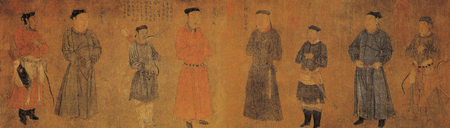
    The 'Four Generals of Zhongxing' painted by Liu Songnian during the Southern Song Dynasty. Yue Fei is the second person from the left.

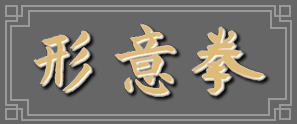
    Hsing I Chuan (aka Xing Yi Quan) is commonly referred to as "Form and Mind" or "Form and Will" boxing. "Hsing" ("Xing") refers to "form" or "shape", and "I" ("Yi") commonly refers to "the mind" or "intent". "Chuan" or "fist" denotes a method of unarmed combat. The mind of the practitioner creates an instantaneous attack and/or defense from the mutable changes of the moment.

    Yue Wu Mu, orginally called Yue Fei (1103-1141), was from the Honan province. He was a national warrior hero fighting back during the invasion of the Jin Tribe. He is one of the best known patriotic generals in China's history. General Yue Fei was credited as the founding father of Hsing I as a result of his attempts to promote Hsing I through his military endeavors during the Song Dynasty (960-1279).

    General Yue Fei created Hsing I Chuan for his officers to learn fighting and teach his troops. Hsing I Chuan traditionally would not be taught to those students with bad or mean dispositions. Hsing I Chuan is known for its martial effective linear movements and the explosive power of its techniques. Although considered by some to be the most simple and linear of the Chinese Styles, its power is derived through spiraling and circling movements that only appear to be linear in Hsing I Chuan's "long arm" approach.

    Hsing I Chuan is believed by many to be the oldest of the orthodox, internal styles of Chinese martial arts, predating both Tai Chi Chuan and Ba Qua (Pa Kua). This art is the second of the three internal styles (Tai Chi Chuan, Hsing I Chuan, Pa Kua Chang).

    There is a story about two great masters: Kuo Yun Shen of Hsing I Chuan and Tung Hai Chuan of Pa Kua. It is said that these two masters engaged in a contest to see whose martial arts were superior. After three days of fighting neither had the advantage or could beat the other. After this contest the two masters agreed that their students could freely study the other master's style. This then formed the relationship of the Hsing I and Pa Kua schools, making them sister systems.

     
    Hsing I (Xing Yi) Chinese Characters

    The art of Hsing I Chuan is divided into two main systems: the Twelve Animals and the Five Elements. The Five Element system is further divided into two main branches: the Hebei and Shan Xi styles.

    The Twelve Animal style is closest to the original Xin Yi Liu He Quan in form and practice. The movements in the forms are patterned after the spirit of various animals in combat, including the Dragon, Tiger, Monkey, Chicken, Sparrowhawk, Eagle, Giant Bird (Tai), Horse, Snake, Swallow, Water Lizard (Tuo), Bear.

    The Five Element based systems have five basic functions: Splitting, Drilling, Crushing, Exploding, and Crossing. These Five Elements form the foundation of the art. The basic energies of the Five Elements are then expanded into Twelve Animal forms which include variations of the animal forms found in the Ten Animal styles as well as two additional animals: the Tai (a giant mythical bird) and the Tuo (a type of water lizard or large reptile).

    These primary styles of Hsing I Chuan are still practiced in different regions of China. The Hsing I Styles or Families are the Shanxi, the Hebei, and the Henan. Each style of Hsing I Chuan is distinctly different in essence and in appearance. The Shanxi and Hebei methods are based upon the Five Elements and the Twelve Animal styles, although the names of the animals sometimes vary a bit from family to family. The Henan style does not emphasize the Five Elements and only uses Ten Animals.


    Click here to visit our
    Hsing I Photo Gallery.
    Hsing I Photo Gallery
     
    Previous Page Hsing I Home Next Page Hsing I Training

     
      Set As Homepage   Add To Favorites   Print This Page   Email This Page   Visited 1037 Times Since 03/27/07   Last Modified 3/23/2007     Provide Feedback   !Discuss This Page   !Rate This Page  
     
    Northern Shaolin Kung Fu and Tai Chi Academy Northern Shaolin Kung Fu and Tai Chi Academy
    619 South Trooper Rd, Audubon, PA 19403
    Copyright © 2008  610.631.9200