|
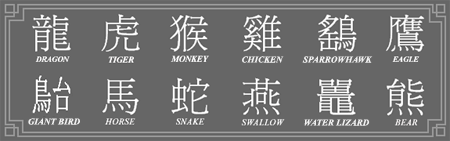
The twelve common animals:
-
Dragon (Long)
This is the only "mythical" animal taught.
-
Tiger (Hu)
-
Monkey (Hou)
-
Chicken (Ji)
It is sometimes known as Cock (Gong Ji).
-
Sparrowhawk (Yao)
Accipiter nisus
-
Eagle (Ying)
In Hsing I "the Bear and Eagle combine". There exists a bird called the "Bear Eagle",
which is considered by some to cover both of the Hsing I characters.
-
Giant Bird (Tai)
"Tai" refers to a mythical bird or a flycatcher native to Asia.
It is sometimes known as Roc (Peng), Dove (Ge), or Phoenix (Feng Huang).
In Chinese mythology there live a kind of giant mysterious fish
in the northern sea, called "Kun", which can turn into giant birds.
When they are in bird form, they are known as "Peng".
"Peng" is bird of giant size and terrific flying power,
also known as the Chinese Roc.
When they fly their wings are like the colorful clouds in the sky.
They travel three thousand miles in one flap of their wings
and can fly for six months without rest.
"Peng" symbolizes ambitions and great accomplishments
and is often used as a given name. Yue Fei was named "Peng".
-
Horse (Ma)
-
Snake (She)
This includes both constrictor and viper.
-
Swallow (Yan)
-
Water Lizard (Tuo)
"Tuo" refers to a type of water lizard, akin to the Yangze river aligator.
It is also known as just Crocodile or Aligator.
It is sometimes known as Turtle (Gui) as well.
"Tuo" can also be translated as "horse", "ostrich", or "fish"
but their symbols are different.
-
Bear (Xiong)
Our first focus is on these animals:
-
Chicken
(Press and Release)
-
Dragon
(Body)
-
Bear
(Shoulders)
-
Eagle
(Gripping)
-
Tiger
(Embrace)
|



 Saturday, June 14
  Site Intro





 YouTube
