


|
| HOME | THE ACADEMY | INSTRUCTORS | CLASSES | SEMINARS | KNOWLEDGE | SHOP |
 
|
Welcome! |
 Saturday, April 26
 |
| WHAT'S HOT |
|
One Week Free Classes & Free Uniform |
| SITE OPTIONS |
 Site Intro Guest Book Contact Us Mailing List Site Intro Guest Book Contact Us Mailing List |
| QUICK LINKS |
Seminars After School Products School Location Testimonials Student of the Month Lion Dance Performance Class Schedule After School Products School Location Testimonials Student of the Month Lion Dance Performance Class Schedule  Coupons Articles Forum Photo Gallery News Event Calendar FAQ Online Store Coupons Articles Forum Photo Gallery News Event Calendar FAQ Online Store |
| SCHOOL SEARCH |


|
| Home -> Classes -> Meditation -> Historic Figures | ||||||||||||||


|
||||||||||||||
Meditation - Historic Figures
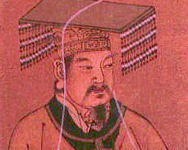
Huang Di (2698 BC - 2599 BC)
|

|
Chinese: 黃帝 Pinyin: Huáng Dì aka Huang Ti |
Huang Di is one of the legendary Five Emperors, a Chinese sovereign and cultural hero who is said to be the ancestor of all Han Chinese. The Yellow Emperor has been credited with the invention of the principles of Traditional Chinese medicine. The Huangdi Neijing (The Medical Canon of the Yellow Emperor) was supposedly composed in collaboration with his physician Qi Bó. However, modern historiographers generally consider it to have been compiled from ancient sources by a scholar living between the Zhou and Han dynasties more than 2000 years later.
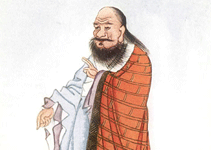
Lao Tzu (between 600 BC and 301 BC)
|
Chinese: 老子 Pinyin: Lǎozǐ Wade-Giles: Lao Tzu aka Lao Tse or Lao Tze |
Lao Tzu was an ancient Chinese philosopher. According to Chinese tradition Lao Tzu lived in the 6th century BC, however many historians contend that Laozi actually lived in the 4th century BC which was the period of Hundred Schools of Thought and Warring States Period, while others contend he was a mythical figure.
Laozi was credited with writing the seminal Taoist work, the Tao Te Ching (also known simply as the Laozi). The Tao Te Ching is one of the most significant treatises in Chinese philosophy. It is his magnum opus, covering large areas of philosophy from individual spirituality and inter-personal dynamics to political techniques. The Tao Te Ching is said to contain hidden instructions for Taoist adepts often in the form of metaphors relating to Taoist meditation and breathing.
Lao Tzu developed the concept of "Tao" often translated as "the Way" and widened its meaning to an inherent order or property of the universe: "The way Nature is". He highlighted the concept of Wei wuwei, or "action without action". This does not mean that one should hang around and do nothing, but that one should avoid explicit intentions, strong wills or proactive initiatives. Lao Tzu believed that violence should be avoided as much as possible and that military victory should be an occasion for mourning rather than triumphant celebration. Lao Tzu said that the codification of laws and rules created difficulty and complexity in managing and governing. As with most other ancient Chinese philosophers, Lao Tzu often explains his ideas by way of paradox, analogy, appropriation of ancient sayings, repetition, symmetry, rhyme, and rhythm. The writings attributed to him are often very dense and poetic. They serve as a starting point for cosmological or introspective meditations. Many of the aesthetic theories of Chinese art are widely grounded in his ideas and those of his most famous follower Chuang Tzu.
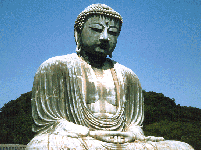
Buddha (563 BC to 483 BC)
|
Siddhārtha Gautama |
Siddhartha Gautama was a spiritual teacher from ancient India and the historical founder of Buddhism. He is universally recognized by Buddhists as the Supreme Buddha of our age. He never considered himself a deity
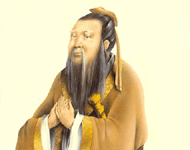
Confucius (551 BC - 479 BC)
|
Pinyin: Kǒng Fūzǐ Wade Giles: K'ung fu-tze (true name) Pinyin: Kǒng Qiū Chinese: 孔丘 |
Confucius was an esteemed Chinese thinker and social philosopher. His philosophy emphasized personal and governmental morality, correctness of social relationships, justice and sincerity. These values gained prominence in China over other doctrines, such as Legalism or Taoism during the Han Dynasty. His thoughts have been developed into a system of philosophy known as Confucianism.
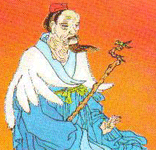
Chuang Tzu (370 BC - 268 BC)
|
"Master Zhuang" Chinese: 莊子 Pinyin: Zhuāng Zǐ Wade-Giles: Chuang Tzŭ aka Chuang Tsu, Zhuang Tze, or Chuang Tse |
Chuang Tzu was a famous Taoist philosopher in ancient China who lived around the 4th century BC during the Warring States Period. Using parable and anecdote, allegory and paradox, he set forth the early ideas of what was to become the Taoist school. Central in these ideas is the belief that only by understanding Tao (the Way of Nature) and dwelling in unity can man achieve true happiness and be truly free in both life and death. Witty and imaginative, enriched by brilliant imagery, making sportive use of both mythological and historical personages such as Confucius, the book which bears Chuang Tzu's name has been savored by Chinese readers for centuries.
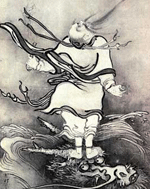
Lu Dongbin (796 AD)
Ancestor Lu
|
Chinese: 呂洞賓 Pinyin: Lǚ Dòngbīn (true name) Chinese: 呂巖 or 呂岩 Pinyin: Lü Yán |
Lu Dongbin or Ancestor Lu is the most famous of the Eight Immortals and revered as a hero of marvelous and infinite wisdom by Taoists. He was favored by court and considered the founder of Dragon Sect of Complete Reality Taoism.


|
Visited 12826 Times Since 03/30/07 | Last Modified 4/7/2018 |


|
|
 YouTube
Facebook YouTube
Facebook
|
 |
Northern Shaolin Kung Fu and Tai Chi Academy 619 South Trooper Rd, Audubon, PA 19403 Copyright © 2025 610.631.9200 |